
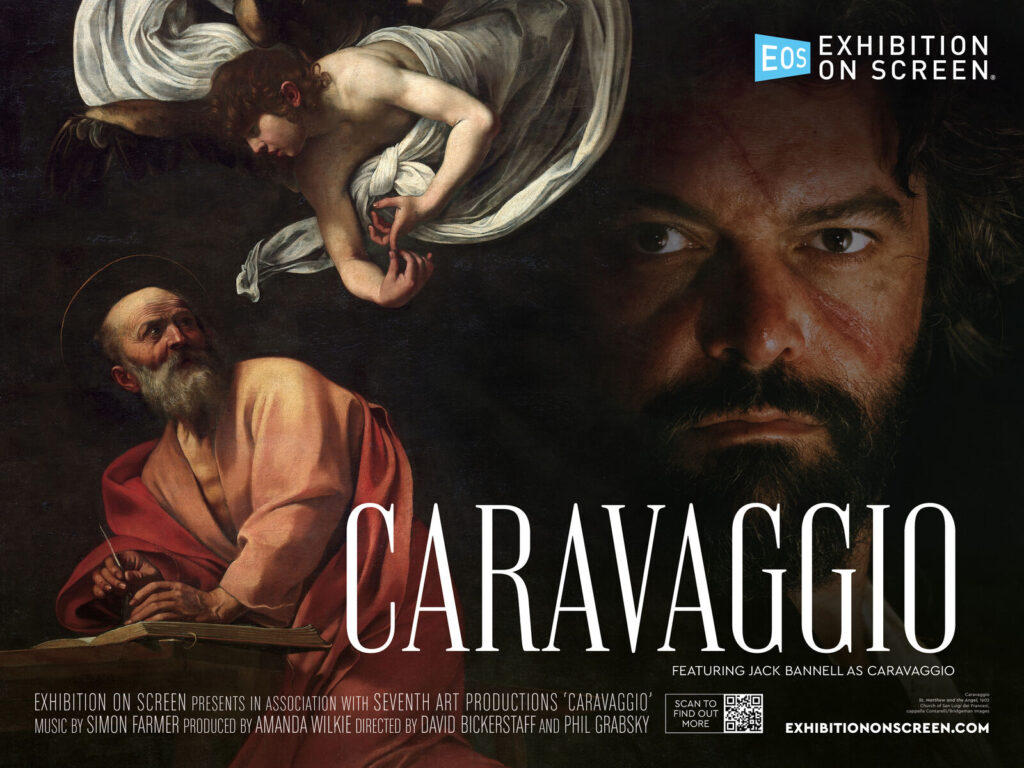
Reviled (or revered) as the Bad Boy of Italian Art, Caravaggio’s reputation seems to be unassailable. The bravura artist that deployed chiaroscuro to bring a cinematic flair to religious iconography, his fan base extends far beyond the art world. The director Martin Scorsese remarked on his ability to craft a scene from light and dark.
In taking a deep dive into Caravaggio’s life and work (the two are deeply connected), the problem is not how to convey what we already know of the artist, it’s approaching him from a fresh perspective. For their latest documentary, Exhibition on Screen examines Caravaggio not just from his position in art history, but within a psychological context. There are good reasons for taking this approach. Caravaggio was not a man to leave a paper trail: he spent the last years of his life on the run from the law after murdering an acquaintance, Ranuccio Tomassoni. Consequently, anyone trying to build a biographical portrait of the man doesn’t have access to diaries or letters. We have little of Caravaggio in his own voice. It is the art that speaks for him.
Responding to this challenge, Exhibition on Screen decided to base their film on a re-imagined Caravaggio. Played by Jack Bannell, we travel across Caravaggio’s life with him as he sails back to Rome, a Papal pardon for his crimes as the sweetener. Bannell’s Caravaggio is charming but paranoid. The camera leans into his face, scars from previous fights clearly visible. He recalls the significant events of his life, but he glazes over troubling memories. His turbulent childhood in Milan played out against the backdrop of famine and plague. In trying to outrun the latest outbreak, his family weren’t so lucky. His father and grandfather died, and on the same day. Scraping money together for an apprenticeship, Caravaggio’s mother sent him to a former pupil of Titian, Simone Peterzano. But Caravaggio’s difficult personality didn’t suit the life of an apprentice, and he travelled to Rome. Starting out with hack work, Caravaggio eventually managed to secure a place with the Pope’s favourite artist, Giuseppe Cesari.
In examining Caravaggio’s legacy, the documentary discusses the innovations Caravaggio made (but never quite got enough credit for). His choice of models, personal friends from Rome’s demi-monde, gives Caravaggio’s mythical and religious subjects a breath of life. There is an authenticity to his faces. There is an irony in that, although Caravaggio could often be his own worst enemy, he could read and interpret other people so well. His paintings exuded drama: emotional flash points of torment, pain, delight and joy. His bohemian, unguarded life in Rome, accentuated by an endless round of fighting, partying and boozing, gave Caravaggio’s art a different flavour. Even in painting subjects from the Bible, Caravaggio’s ability to evoke psychological realism gives his paintings an edge. In Judith Beheading Holofernes, Caravaggio’s model scowls as she draws a sword through Holofernes’ neck. There is, in her expression, a sense of conflict. We see it again in Salome Receives the Head of John the Baptist. Salome, having asked for his head as a prize, now cannot bring herself to look at it. Caravaggio grins conspiratorially, as he remarks to us how difficult it was to capture the actual moment of death and balance it with a morally ambiguous narrative. He nails both.
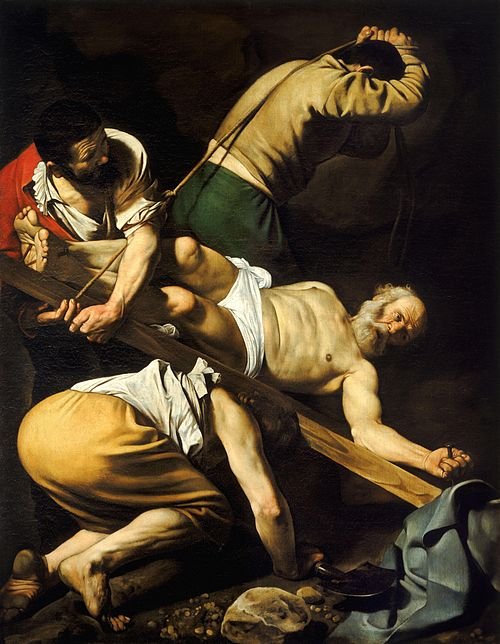
While many of Exhibition on Screen’s films have centred around a particular exhibition, Caravaggio leans into the breadth of the artist’s achievements, giving the documentary an expansive feel. The film’s commentators, who include historian Helen Langdon and author Fabio Scaletti, remark on Caravaggio’s use of light. His use of chiaroscuro (using a strong contrast of light and dark to build drama) is Caravaggio’s calling card. He uses light to expose and illuminate: the action emerges, suddenly, from the darkness. There is a filmic sensibility with Caravaggio, and his art tips heavily into horror and gore. In The Crucifixion of Saint Peter, Caravaggio captures the moment Saint Peter is being prepared for crucifixion. Already nailed to the cross, Peter has requested to be crucified upside down, as to not rival Christ. We see him at the point where workmen are struggling to bring the cross to a standing position. We see their backs and grubby feet as they sweat and strain. Peter is now realising the extent of his ordeal. The terror on his face needs no interpretation. It is a light of revelation, rendered in its bleakest tone.
It is this emphasis on Caravaggio’s ability to bring psychological insight to his art that leads the documentary to make another crucial point. In what we know about him, Caravaggio undeniably had a hot temper. He was often in scrapes: the few pieces of evidence for him we do have are police reports. There is an assumption that this makes up the lion’s share of his personality. But the film cleverly points out that at his height, this was an artist working with the Catholic Church and Italy’s richest aristocrats. To get commissions, and keep getting them, he had to be on his best behaviour. This insight is important as it allows us to think of Caravaggio in a more rounded way. While he never had students or apprentices, he was able to build solid working relationships. The image of him as a knife-wielding hothead has appeal, but it’s not the whole truth.
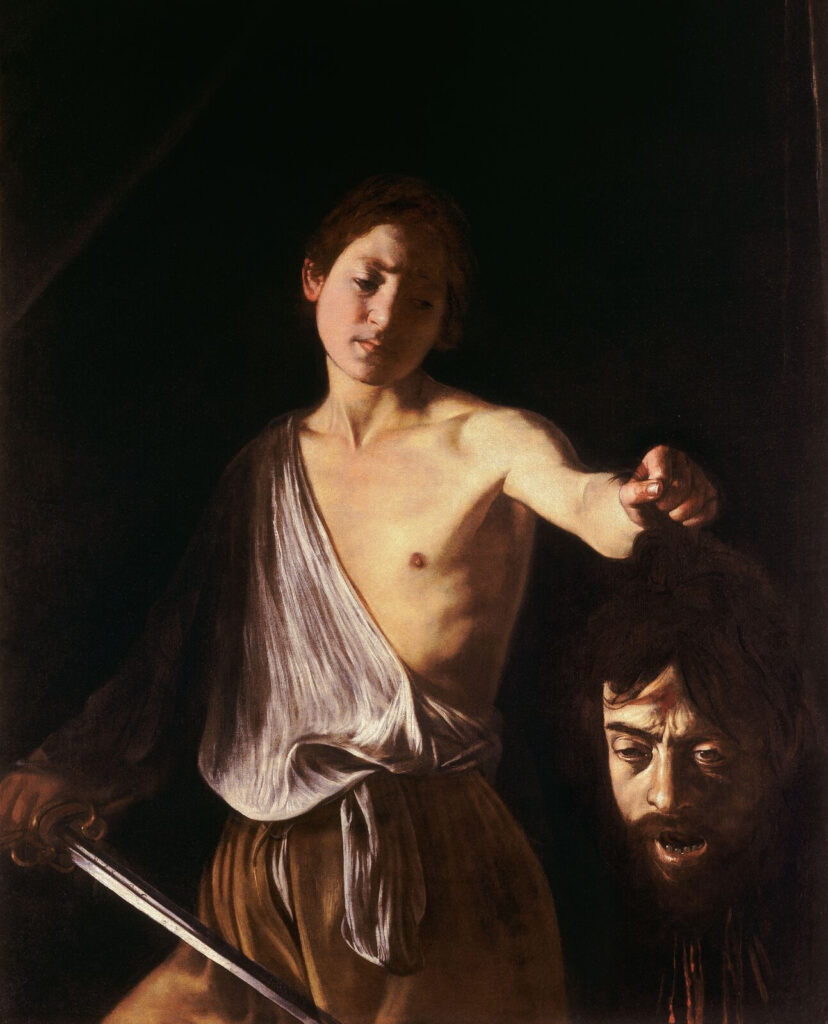
With a life pitched between the heights of respectability and evenings spent in the shadows, Caravaggio’s ability to depict the complexity of human nature is strikingly modern. In The Taking of Christ, Caravaggio paints Judas’ betrayal of Christ, from the perspective of the Bible’s most complicated villain. David with the Head of Goliath sees Caravaggio feature himself in a rare self-portrait, not as the heroic and youthful David, but as the beleaguered Goliath. There is a psychological tension in his later art that directly echoed what was going on in his life. Now on the run, Caravaggio bounced from Naples to Sicily to Malta. He found favour with Malta’s elite, until his temper got the better of him again. His last days are sparsely documented. Even with all the academic research on Caravaggio, it is not known how he died or where his remains are buried.
While the balance of commentary and VIP access to Caravaggio’s paintings is what we would expect from Exhibition on Screen, their biggest gamble was in re-creating the character of Caravaggio. While this technique can work (Benedict Cumberbatch was horribly plausible in Vincent Van Gogh: Painted with Words), the premise can come off as a bit naff. Jack Bannell’s characterisation of Caravaggio is playful and charismatic. He shows off the best of the artist. But when the conversation turns tricky, Bannell’s Caravaggio becomes evasive. He skates over the details of how he came to be wanted for murder, which feels entirely believable. He wants to impress us with his stature, and his moments of weakness don’t fit into that narrative. The inability to take responsibility for his actions is at the core of Caravaggio’s character. Digging into that character has, for Exhibition on Screen, paid dividends, because in examining aspects of the man, we learn about how and why he painted the way he did. This hard lean into the artist’s psychology works perfectly for Caravaggio because the artist left so much of himself on the canvas.
The story-telling techniques of Caravaggio are a departure for Exhibition on Screen, but it builds an intimacy between the viewer and the artist that can’t be created from first-hand sources. What doesn’t exist, after all, has to be imagined. The documentary succeeds on every front: a creative leap of faith, combined with insights into Caravaggio that progress our understanding of his art. Exhibition on Screen has another hit on its hands.
Exhibition On Screen: Caravaggio is screening at Plymouth Arts Cinema from 18th – 22nd November.
Reviewed by Helen Tope

Comments
No comment yet.