
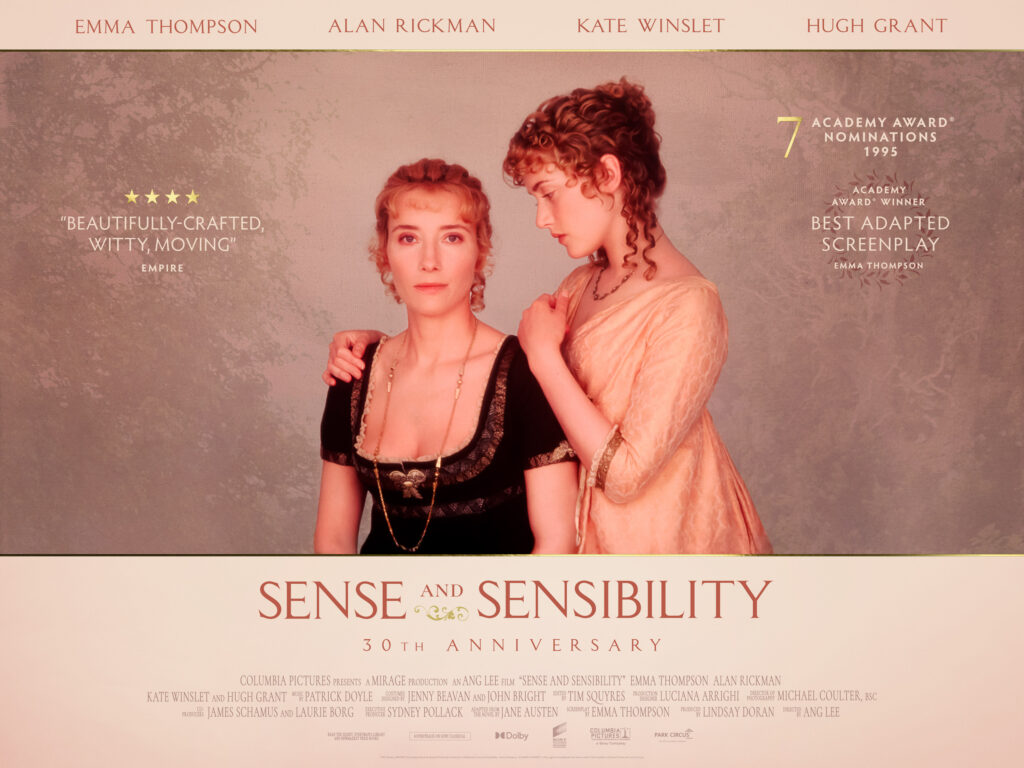
Although it doesn’t get the same attention as Pride and Prejudice, Persuasion or even Emma, Sense and Sensibility can lay claim to being Jane Austen’s literary debut. Published in 1811, it did well. Its original critics described the novel’s plot as “probable, highly pleasing and interesting”. While she didn’t get the literary hoopla of a new release by Rebecca Yarros or R.F Kuang, Sense and Sensibility got Jane Austen’s foot in the door of the publishing industry.
What is particularly noticeable about the novel is that its plot covers many of the themes we see cropping up in later books. Sisters Elinor and Marianne Dashwood face a significant reversal of fortune when their father dies, and the family estate, Netherwood, reverts to his eldest son. The girls, with their mother and youngest sister, Margaret, receive an invitation to stay in Devon from their mother’s cousin. Elinor has to reluctantly leave behind a blossoming relationship with Edward Ferrars; the brother of Elinor’s sister-in-law (some Austen hook-ups don’t stray that far from the family tree). Austen adds further romantic interest as Marianne is rescued from the trauma of a (checks notes) sprained ankle during a rainy walk with Margaret. Her saviour, John Willoughby, is the epitome of Regency masculine elegance. His flirty, engaging personality and love of Romantic poetry, means that Marianne falls HARD. So much so, she has failed to notice that she has also caught the eye of Colonel Brandon. A friend of their cousin’s, he is older (pushing forty-five), and in comparison to the dashing Willoughby, perhaps a little too dependable, even dull. As the novel progresses, Jane Austen puts both Elinor and Marianne to the test, forcing them to make difficult decisions, as characters’ true natures, and motives, are revealed.
In terms of making it to the big screen, Sense and Sensibility hasn’t inspired as many film-makers as the perennial favourite, Pride and Prejudice. On the surface, it lacks the later novel’s sparkle. There’s no fiery face-off between Elizabeth Bennet and Lady Catherine de Bourgh to get our teeth into. There are few set pieces. It is a very “interior” novel: most of the action takes place in someone’s drawing room; getting caught in the rain initiates the novel’s moments of high drama. To make a successful film of Sense and Sensibility, it would take imagination.
At this point, Emma Thompson enters the frame. A reader of Jane Austen since the age of 11 (really), the actor was ideally placed to write a screenplay. Crucially bypassing the traditional route of Austen adaptations, understanding that literature and film are two separate mediums, Thompson created a screenplay that would speak to the average cinema-goer. Gone are the verbatim chunks of dialogue lifted straight from the novel, and in its place, Thompson wrote a modernised script that was well-paced and cinema-friendly. For film trivia fans, it is also worth noting how close the film came to disaster before even a single scene was shot. The screenplay was nearly lost when Thompson’s computer crashed. To her rescue was friend, and self-confessed computer geek, Stephen Fry. The screenplay was luckily retrieved.
Within the first minutes of the 1995 film, it is obvious we are not in classic Austen territory. The characters chatter among themselves so freely, we feel as if we are eavesdropping. A husband and wife arguing, sisters bitching about their miserly sister-in-law. This easy entry into Austen’s world was Emma Thompson’s intention: the core of her screenplay is accessibility. The film can be watched – and understood – by someone who is a complete newcomer to Jane Austen and the history and culture of Regency England. No prior knowledge is needed. But Thompson doesn’t simplify: she clarifies. The emotions are sharply drawn, right from the start. There is humour, pathos. The emotional connection is central. Thompson’s triumph is making us look past the costumes and into the heart of the drama. They are no longer characters on a page, but living, breathing people.
The key to getting it right was Thompson acknowledging the themes and concerns important in Austen’s world. A confirmed Austen fan, Thompson’s familiarity with the material definitely comes across in the film. There is also a feminist angle to Thompson’s screenplay, that Austen implies but never outright declares. Wanting to follow your heart, but being obliged to think of your family’s future; the lack of choices available to women especially in terms of earning their own money; a society that prefers an unhappy marriage to a messy divorce. Thompson doesn’t tell us, she shows us.
The sense of freedom, in really adapting the source material, is also evident in its directorial style. Directed by Ang Lee, the” interior” novel is turned inside out: the characters are rarely filmed indoors; good use is made of the Devonshire countryside the sisters find themselves in. Dartmoor’s brooding skies and rough terrain get their starry moment. The film, bathed in light and colour by cinematographer Michael Coulter, feels airy and expansive, thematically and emotionally. Shot in a muted, Gainsborough palette, Kate Winslet as Marianne is less whiny teenager, and more a young woman on the precipice of a life-changing decision, one that will not only affect her, but her entire family. Thompson makes us acutely aware of what is at stake.
Sense and Sensibility is one of those rare films where everything comes together. While the casting of Hugh Grant as Edward Ferrars, straight off his star-making lead in Four Weddings and a Funeral, did cause consternation among the Austen purists (too handsome); the blend of new faces and Thompson’s pals doing a cameo are a successful combination. Kate Winslet and Greg Wise as Marianne and Willoughby not only look good together, their chemistry is sweetly romantic and charming. Emma Thompson casting herself as Elinor was also considered a controversial choice at the time: in the novel, Elinor is only 19 years old. But the decision to make the sisters’ age gap more pronounced reads better to a modern audience. Also playing against type, Alan Rickman as Colonel Brandon takes on the unlikely role of older romantic rival. Best known at this point for his villainous turn in Die Hard, Rickman’s playing of Brandon is beautifully nuanced. Thompson makes it clear that he is no consolation prize, but a serious contender for Marianne’s heart.
You do get the impression that casting raided Thompson’s address book for the rest of the cast: Cambridge Footlights is well represented here. Imelda Staunton, Hugh Laurie, James Fleet and a deliciously arch Harriet Walter make the most of their time on screen; Imogen Stubbs is great in her sly, fox-like role of Lucy Steele. Anchoring the film are veteran actors Elizabeth Spriggs and Robert Hardy. In her film diaries, Thompson noted that they were cast because they inhabited the 18th century effortlessly. Their impish humour lifts the film’s darker moments.
What is interesting in re-watching Sense and Sensibility now is how little it has aged. Emma Thompson’s choice to make an accessible, cinema-literate version of Austen was years ahead of its time. The film was a huge success on its release. Sense and Sensibility was a global hit (particularly big in Uruguay, according to Thompson). The reason why it connected with audiences was Thompson’s determination to make Austen’s characters relatable to people who had never read a word of her, without dumbing down what makes the novel important. This is something film-makers still struggle with today, when approaching Austen’s work. The lush, romantic elements with a dash (pun intended) of pragmatism, makes this adaptation of Sense and Sensibility a must-watch, not only for Austen fans but for anyone who thinks a costume drama can’t be enjoyable. Thompson’s sense of fun takes the starch out of the novel’s formality but at the same time, heightens the sense of drama. Nominated for 7 Academy Awards, with Emma Thompson taking home the gold for Best Adapted Screenplay, Sense and Sensibility is the perfect example of a film that takes Austen, but not itself, seriously.
Bring your knitting, crochet or other craft project to work on at our Knitflix screening of Sense and Sensibility at 2.15pm on Saturday 13th September, or just come and enjoy the film on Tuesday 16th at 5.15pm.
Written by Helen Tope






Comments
No comment yet.