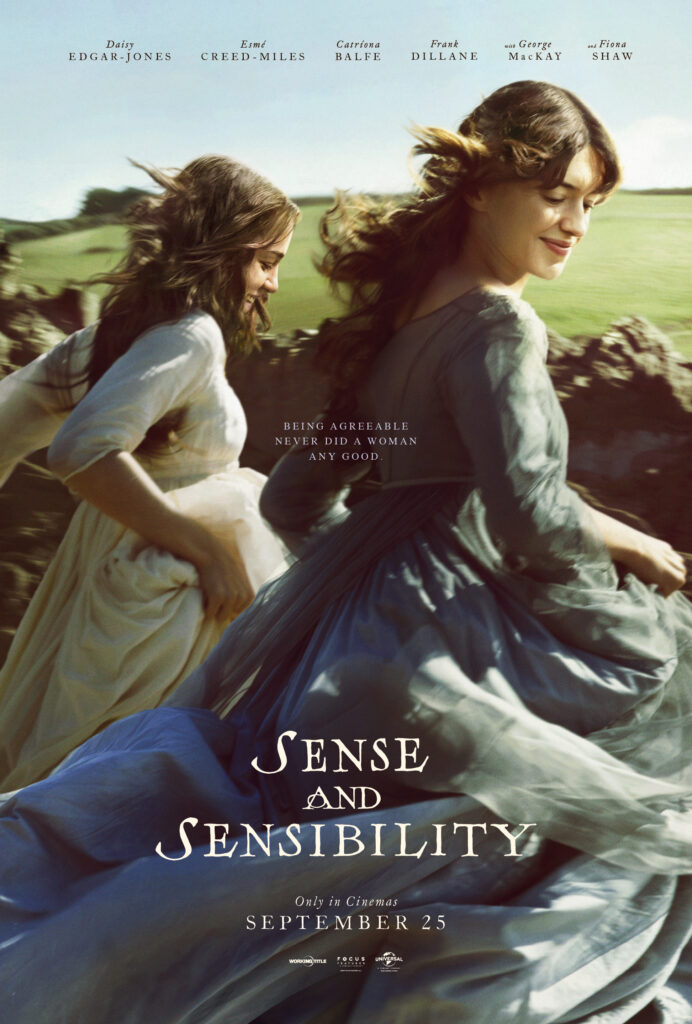
For Jane Austen fans, waiting for a new Austen film can be a frustrating experience. Nothing for years, and then two come along at once. While the Netflix / Dolly Alderton version of Pride and Prejudice isn’t out until December, we do have a new Sense and Sensibility that is fully dialling into those autumnal vibes.
It’s also an auspicious date, as hard-core Janeites well know. It’s been thirty years since the release of Ang Lee’s Sense and Sensibility. A starry adaptation featuring the cream of British acting talent, a superb, Oscar-winning screenplay from Emma Thompson, it quite rightly holds its place in the top-tier of Austen adaptations. In short, it’s a hard act to follow.
To recreate Austen’s 1811 novel for the 21st century, director Georgia Oakley takes a leaf out of Joe Wright’s 2005 Pride and Prejudice. Take away the spotted muslin frocks and genteel interiors, and examine what is left. Oakley’s vision of Austen is firmly realist. We meet the Dashwood sisters at a turning point in their lives. As their father dies, their family home is automatically passed down to his son from an earlier marriage. Girls inherit nothing. As John Dashwood (played by Tom Brooke) arrives with his wife, Fanny (a gleeful performance from Stacy Martin), the girls and their mother are uprooted and their options are limited. As Fanny makes herself too comfortable (there is a deliciously venal moment where she literally counts the family silver), she invites her brother, Edward to see how she’s done for herself. Edward Ferrars (George MacKay) is cut from a different cloth to his sister. His gentle manners, aware of the Dashwood’s recent bereavement, charm the family and he catches the eye of eldest daughter, Elinor (Daisy Edgar-Jones). This budding romance is cut short when the Dashwoods are offered a new place to live in Devon by their relative, Mrs. Jennings (Fiona Shaw).
Oakley wisely, as Ang Lee did, uses Dartmoor as a backdrop to the Dashwood’s new life. In this film, the clouds glower. There is, as locals would expect, always the chance of rain. What is immediately obvious in Oakley’s film is that the cheeriness of Ang Lee’s optimistic lean into Sense and Sensibility takes on a different hue for 2026. The interiors are dimly lit, in a palette of black, brown and cream; the moors are impressive but never quaintly picturesque. In a neat metaphor, costume designer Grace Snell reimagines the light-as-air frocks of the 1996 version. Here, they are more voluminous and weighty. You can feel the effort of a country walk with mud pulling down the hems. Oakley, and screenwriter Diana Reid, have clearly done their research and given their Sense and Sensibility an 18th century feel, as Austen herself was deeply influenced by the earthy and often bawdy novels of Samuel Richardson and Henry Fielding. There is a Regency sensibility here, but there is also a looseness that references an earlier age. The provincial country dance the Dashwoods are invited to, thrums with life. The film sharply criticises the hypocrisy of Regency society: a system that would quite happily turf a vulnerable family out of their home, while at the same time, crudely assessing the Dashwood sisters for their marriageability. As Elinor waits for a visit from Edward, her sister Marianne (Esme Creed-Miles) chances upon love with local boy and charmer, Willoughby (Frank Dillane). Mrs. Jennings’ hopes of an alliance with their older, but duller, neighbour Colonel Brandon (Herbert Nordrum) falls by the wayside. The scenes with Willoughby and Marianne reading poetry on the moors nail the romantic yearning that was missing from Emerald Fennell’s Wuthering Heights. As Marianne finds herself falling deeper in love with Willoughby, she scoffs at Elinor’s suggestion that she should show less than she feels. Marianne is a Romanticism girl, right to her fingertips.
The success of films like these rest on the chemistry between the characters. While Austen purists riled at the casting of Hugh Grant as Edward in the 1996 film, he did have an enjoyable connection with Thompson’s Elinor. Few girls would have a problem conjuring chemistry with Alan Rickman’s Brandon: far hotter than Austen intended, but it worked. Here, the chemistry is present but a little uneven. The relationship between Marianne and Willoughby takes a back seat to the very palpable connection between Daisy Edgar-Jones and George MacKay. In other adaptations, Edward Ferrars has always played third fiddle to Willoughby and Brandon in the leading man stakes, but this is very much MacKay’s film. His presence on the screen leaves everyone else in the shade. It’s not too much of a stretch to imagine this Sense and Sensibility doing for George MacKay what it did, in 1996, for Kate Winslet.
Fiona Shaw is the other standout in this film: to be fair, her accent wanders from broad Devonian to Irish and back again (all in a single sentence) but her joie de vivre provides a welcome relief. Reid’s choice to include minor characters, such as Lady Middleton, is interesting and plays into Oakley’s determination to portray Austen from all angles. Played by Chloe Pirrie, she is another female character damaged by the confines and expectations of a society that demands compliance and supplication, while offering so much less.
This is a film that has made deliberate choices to distance itself from its Nineties cousin. Whether you want to attribute it to a post-pandemic malaise, or the result of creatives eyeing an uncertain future, this Sense and Sensibility lacks the warmth and humour of Thompson’s screenplay. In its place is a distinct uneasiness: the Dashwoods have seen how quickly their lives can be upended: they take nothing for granted. The playing of the youngest Dashwood sister, Margaret, by Bodhi Rae Breathnach, is subdued and wary. Even as she stuffs her face with Dartmoor blackberries, you get the impression it’s less about indulging the senses than finding comfort after a great deal of upheaval.
The question is whether this interpretation of Austen’s novel works for you. If you were feeling ungenerous, you could criticise the 1996 film for its historically inaccurate brightness, and cast that came largely from Emma Thompson’s address book. Although eyeing the credits of this version, the number of double-barrelled surnames hint at a cast that would know instinctively what fork to use. The cynics among us would note the lack of class diversity still present in the film world, thirty years on.
It’s not so much about saying which film is best, but fans will have their favourite. While Ang Lee’s interpretation of Austen is rightly now a classic, Georgia Oakley has found nuance and depth in Austen’s love of the 18th century that feels genuine. The performances are more understated, and the look of the film isn’t just due to current trends in film-making, but a real comment on the psychological state of a creative industry continuously under fire. Oakley’s Sense and Sensibility is definitely darker and sombre, which means it will resonate with some, while leaving others cold. But in Oakley’s realism, there is still a love and respect for the characters and the novel itself. Your perception of this film will come down to a matter of personal taste, and how you like your Austen. But Oakley knows she can look forward to an eager reception from a group of fans who’ve been very, very patient. Janeites, assemble.
Sense and Sensibility is screening from 2 – 8 October, with a Knitflix screening on Saturday 3rd, where you can bring your own crafts to work on.
by Helen Tope