
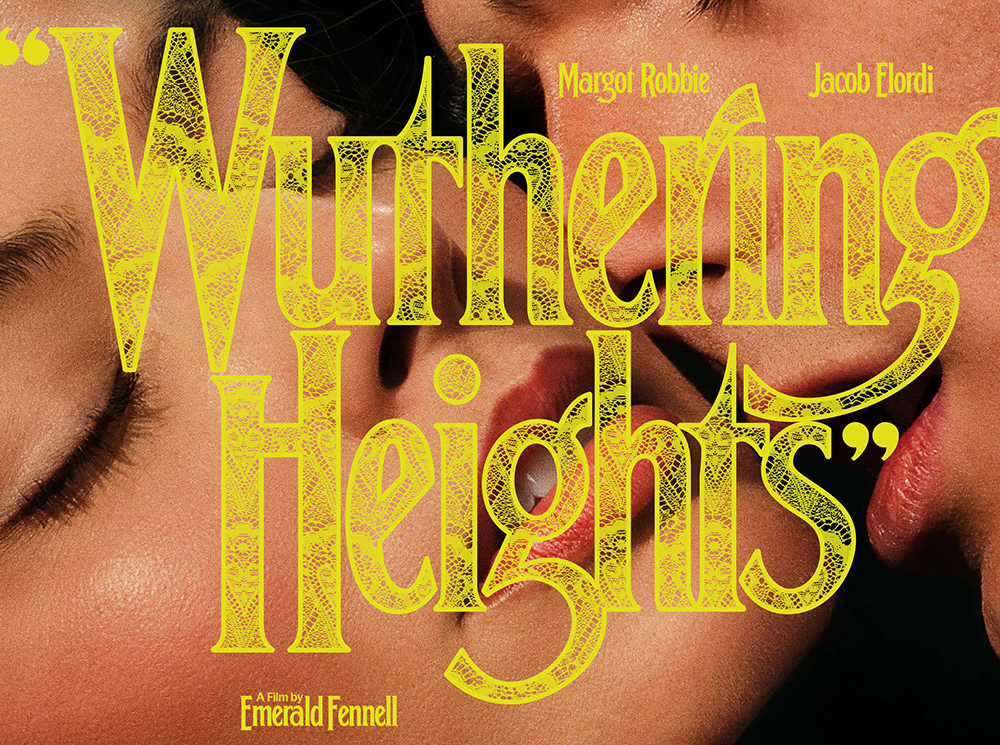
There are few books that shorthand themselves so readily as Emily Bronte’s 1847 novel, Wuthering Heights. Windswept moors, doomed lovers, youthful angst. A passionate, yearning love for the ages. It’s an easy sell. But Bronte’s multi-generational saga presents several challenges to the film-maker who wants to adapt it for the big screen. Its complex structure; it has not one but two (highly) unreliable narrators, and when adapting the book in full would mean your film’s running time would be 5 hours long, where do you start making cuts?
It is interesting to note that no Wuthering Heights film, and there have been many, has adapted Bronte’s novel from start to finish. Every cinematic outing has been, to a greater or lesser extent, a compromise. When director and screenwriter Emerald Fennell announced that her film would be based on her memories of reading the book when she was 14 years old, internet speculation on the project went into overdrive.
In theory, there is logic behind this decision. Concentrating on the relationship between Heathcliff and Cathy, Fennell would be directly appealing to an audience who loves story in broad strokes (think of James Cameron’s Titanic). But nostalgia’s a funny thing. What delights us at 14, can take on a different hue altogether in adulthood. In ignoring an entire chunk of the novel, where Wuthering Heights explores themes of abuse, cruelty and revenge, Fennell’s edit becomes less about screen time, and more about presenting Bronte’s novel not in its complexity, but as a single note.
The first controversy came when the casting choices were announced: Jacob Elordi as Heathcliff and Margot Robbie as Cathy. Again, there is logic at work here: 14 year old girls LOVE Jacob Elordi. But what jumps out, in even a casual reading of Emily Bronte’s novel, is that Heathcliff is explicitly referred to as “dark-skinned”. Readers and academics have tussled over this phrase: some have interpreted it to mean that Heathcliff, whose origins are kept obscure, came from a Spanish or Italian background. Others posit that he was possibly of African or even Indian descent. The accusation of “white-washing” is a fair one, but Fennell would not be the first director to overlook this rather crucial detail. Previous Heathcliffs include Laurence Olivier, Ralph Fiennes and Tom Hardy. The last adaptation to really dig into the racial abuse heaped on Bronte’s leading man was Andrea Arnold’s 2011 film, where actor James Howson was cast as Heathcliff. When played by a Black actor, the expulsion of Heathcliff from the family home, to work in the stables when Cathy’s father dies, becomes charged with deeper meaning.
The decision to focus entirely on the first half of the book, means that in Fennell’s “Wuthering Heights” we do not see the later cycles of abuse and violence that perpetuate themselves through the family’s toxic dynamic, with Heathcliff as the central aggressor. The choice to lean into the ‘romance’ of Wuthering Heights is not so much a mis-reading, as a fundamental misunderstanding. In its themes and tone, Wuthering Heights is sheer Gothic horror. It has more in common with Frankenstein than Pride and Prejudice. If you’ve seen the film poster for “Wuthering Heights”, the pulpy, 1970s romance paperback vibe reads as adolescent fantasy. Fennell interprets obsession for passion, and physical violence for…err…passion, in a way that will be familiar to anyone who’s read Colleen Hoover. While it will play well to that corner of BookTok that can’t get enough of the ‘dark romance’ trope, it really does hammer home that Fennell doesn’t have a firm grasp on her source material.
To dig into the ‘romantic’ aspect of Wuthering Heights, you’re going to need a leading couple with bags of chemistry. Unfortunately for Emerald Fennell, hiring two of the most popular and in-demand actors doesn’t necessarily equal fireworks. You will have seen Elordi and Robbie give great performances, but here they are lacklustre. Their scenes together are bloodless: there’s a lot of throwing each other around and an illicit bit in a carriage, but you feel nothing. There are no sparks between them whatsoever. Elordi and Robbie really do try, but Fennell’s script moves from dialogue lifted from Bronte’s novel, straight into words of her own. There is no attempt by Fennell to adjust her dialogue to suit the era of the book. The disconnect between her words and Bronte’s is so jarring, no actor could make them work. The passion is very much performative, and this might convince cinema goers who are new to the WH universe, but if you remember Laurence Olivier and Merle Oberon in William Wyler’s 1939 film, this is just going to upset you.
There has also been a lot of internet chatter about the look of the film. In her (one-star) review, the Independent’s film critic, Clarisse Loughrey, places Jacqueline Durran’s costume design within the context of classic films such as Jean Cocteau’s La Belle et La Bete. While the rest of the cast are dressed era-appropriately, Margot Robbie bestrides the Yorkshire Moors in dresses that would not look out of place in a pantomime. The gowns, deliberately overblown and all for effect, range from grim to gorgeous. The element of spectacle is practically a supporting character in this film: the can’t-miss-it styling references everything from steampunk to the New Romantics. There is even a repeated motif of jewelled crosses, a sly nod to Emerald’s father, jeweller Theo Fennell. But the problem is there are plenty of ideas on show, but no unifying concept. The jump from the grimy, realist squalor of Wuthering Heights to the lush, highly colourised interiors of their neighbours’ house, Thrushcross Grange, highlights the main problem with the film. A decision needed to be made on whether this adaptation should be traditional or transgressive. While Fennell throws in some daring stuff – a public hanging that ends in a Patrick Suskind Perfume style orgy – you will find yourself longing for the subversion of Promising Young Woman and even Saltburn. Tonally, the film sits somewhere between the expected visual language of Wuthering Heights, and the film that Fennell should have had the guts to make. Using the novel as a jumping off point, there was an opportunity to go all out, and really push the themes and characters of the novel – they can definitely take it. Fennell’s lack of courage is ultimately what sinks this adaptation.
But it’s not all bad. It appears that while Fennell was coaching Elordi and Robbie, the supporting actors were left to their own devices to develop their characters. As Cathy’s dad, Martin Clunes (yes, actual Martin Clunes) is superb as a drunken, feckless lout. Fennell, wisely, gives him much more screen time than the character gets on the page. In another inspired casting, Alison Oliver grabs the spotlight as Cathy’s neighbour, Isabella Linton. The sister of Edgar, who Cathy marries instead of Heathcliff, this character is normally sidelined in adaptations as a fragile, Gainsborough beauty who is collateral damage at most. Oliver clearly assumed that Fennell was heading in the ‘transgressive’ direction and depicts Isabella as a garrulous but desperately unworldly woman who gets caught in the cross-hairs of Heathcliff and Cathy’s psychodrama. Isabella’s slide into degradation, as she foolishly marries Heathcliff on the rebound, is a performance built on incredible choices by Oliver. In a film where not a lot stands out, Oliver is unforgettable.
The really disappointing thing about “Wuthering Heights” is how little atmosphere it creates. Fennell’s world building is of grime and rain, but rather than feeling oppressive, you worry about Robbie catching a sniffle. For all the promotional talk of big, sweeping emotions, everything feels small and undefined. It all circles back to a film maker not understanding what Wuthering Heights is really about. The potential for a truly ground-breaking adaptation was there, but what we have is a film that, in ditching much of the novel’s plot, has lost a lot of its meaning. “Wuthering Heights” did not need to be a page-for-page, faithful adaptation but it did need, at its heart, an understanding of what Bronte was saying in the book. Leaving things out is fine, but it’s important to know why they were there in the first place. Fennell’s film isn’t so much a disappointment as a foregone conclusion. Its lack of depth, emotional and intellectual, will appeal to a certain audience. It is, in its superficiality, a very contemporary adaptation, that doesn’t reflect well on our society’s unwillingness to engage with complex and uncomfortable ideas.
As Fennell’s “Wuthering Heights” joins the roster of Bronte adaptations, perhaps its legacy will be an encouragement to film fans to seek out those other interpretations. There are plenty of them out there, and they will almost certainly be better than this one.
Wuthering Heights is screening at Plymouth Arts Cinema from Friday 27th February – Thursday 5th March.
Reviewed by Helen Tope

Comments
No comment yet.