
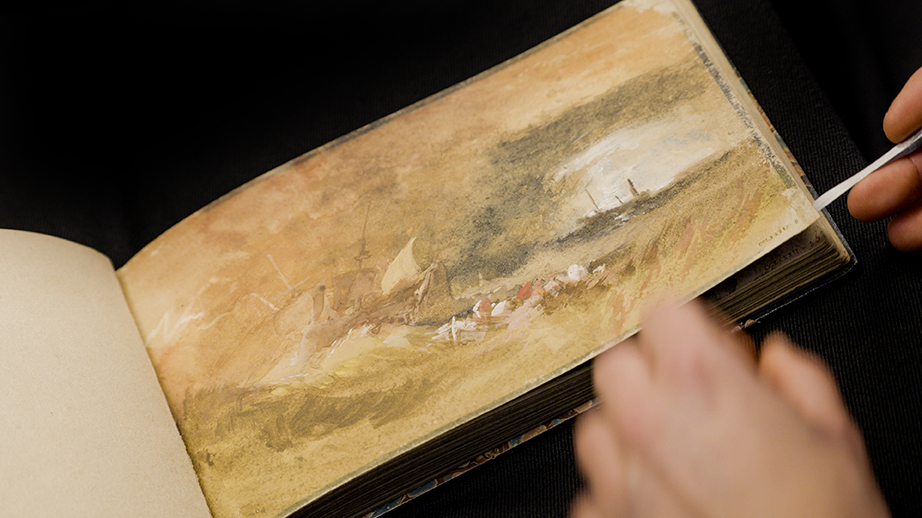
J.M.W. Turner (1775–1851) and John Constable (1776–1837), though contemporaries and arguably the two greatest British landscape painters of their time, seemed to develop vastly different artistic styles. Like the social media of today, the newspapers of the period did not hold back on criticising the overuse of the colour yellow by Turner and the white splatter used by Constable to depict the scattering of light.
They were frequently contrasted as “fire and water” or “poetry versus truth.” This was underlined at the Royal Academy Exhibition of 1831 when Turner’s “Caligula’s Palace and Bridge“ was hung alongside Constable’s “Salisbury Cathedral from the Meadows.” Even their titles indicate Constable’s cosy portrayal of the landscape of the present day, compared to Turner’s dramatic exotic scene of an imagined mythical landscape of the past. This ingrained the impression that Turner was a romantic artist of the imagination, whilst Constable was a grounded artist of the contemporary British landscape.
This perceived rivalry is challenged by David Bickerstaff’s documentary (for Exhibition on Screen) that shows there were as many similarities between them as there were differences.
Both were driven to create and elevate their art at the cost of anything else, and shared the need to experiment with new techniques and technology. In terms of colour, they both used unconventional colours. In the case of Turner, he prominently used reds, orange tones and yellows to convey light, speed, and atmospheric “fire” of the landscape. Constable used cool blues, greens and whites as his “water” to illustrate the transient light and freshness of the British countryside. Both constantly sketched fleeting moments of light and movement that they collected for their larger artworks.
As this film shows, and why Tate Britain put on their exhibition of both their works, Turner and Constable were equally inspired by past masters like the 17th-century landscape painter Claude Lorrain, and they were constantly aware of each other’s work. Whether they were fiercely battling each other as the media of the time enjoyed exaggerating or whether they had a friendly rivalry and respect for each other’s work, they both achieved their goal of elevating the importance of landscape art, and went on to be an inspiration for impressionism and other artistic movements.
Using the Romantic poetry of James Thomson read by Robert Lindsay, that inspired both artists, combined with the footage of their artworks, we get an intense insight and enjoyment of the sublime beauty, scale and ambition of these landscapes that still power our imaginations 250 years later.
“Turner & Constable: Rivals & Originals” running at the Tate Britain until 12 April 2026.
Exhibition on Screen: Turner & Constable is screening on Thursday 9 April at 6pm.
Reviewed by Nigel Watson

Comments
No comment yet.