
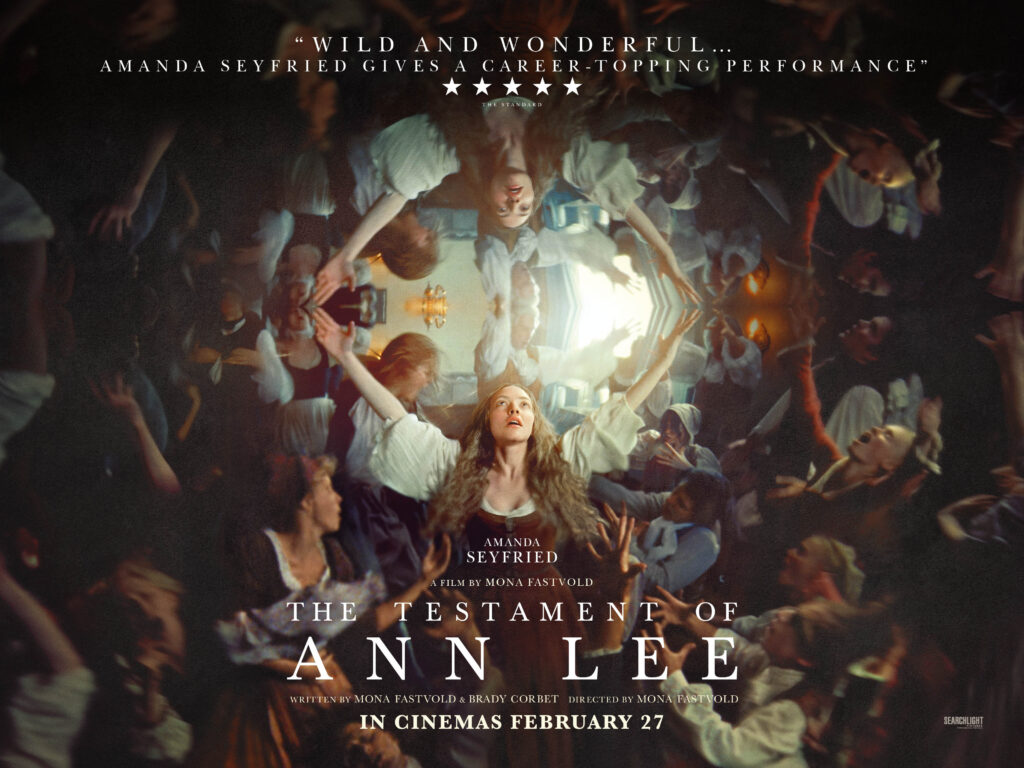
The film opens with a mesmerising depiction of the Shakers’ ecstatic woodland dances. This sets the stage to go back a few years earlier to Manchester, England, in the 18th century, where the roots of this fervent religious movement are revealed.
Initially, the movement was a small, private sect known as the “Shaking Quakers” led by Jane and James Wardley. Ann Lee (played by Amanda Seyfried) joined them and quickly emerged as a transformative figure, becoming their guiding light and inspiration.
It shows that Lee had a harsh upbringing, along with her siblings, who worked from a young age and suffered at the hands of an abusive father. She was particularly close to her brother William (played by Lewis Pullman), who became a key player in the Shaker’s leadership and spread of the movement.
After several personal tragedies, Lee had a series of profound religious visions, in which it was revealed to her that God was both man and woman, and henceforth she advocated total lifelong celibacy to absolve humanity of original sin.
Her followers revered her as the female incarnation of Christ, calling her “Mother Ann” and “Ann, the Word.” Her role as a female preacher in the 18th century was revolutionary, yet it posed challenges when she sought to convert new followers. Nonetheless, a spell in prison did not thwart her intense belief in her visions.
To escape this hostility, Lee and her followers emigrated to America in 1774. It was a perilous journey on an old and hardly seaworthy vessel, and even the crew and their captain were extremely hostile to the raucous singing and dancing of the Shakers.
Using a combination of spiritual guidance and hard work, they eventually established several communities in the US. Their “Hands to work, hearts to God,” attitude helped build self-sufficient communities. Any form of ornamentation was regarded as a sin of pride; therefore, their minimalist, yet highly functional, craftsmanship created the Shaker style of furniture.
They prevailed despite complaints about their whooping and naked dancing in the woods at night and their views on pacifism that bordered on treason. Their refusal to bear arms was especially dangerous during the American Revolution and the Civil War.
Directed by Mona Fastvold, the film intricately explores the unwavering determination of Lee and her followers, capturing their relentless pursuit of faith amidst societal and personal adversities.
Amanda Seyfried, as Lee, gives a powerful performance as she goes through intense physical and psychological traumas that induce intense belief in her followers and accusations of witchcraft from her detractors.
Cinematographer William Rexer used 35mm film and candlelit-scenes, inspired by the works of Rembrandt and Caravaggio to capture a sense of that historical period. And, Celia Rowlson-Hall’s interpretive “thrusting” dance movements, paired with Daniel Blumberg’s reimagined Shaker hymns featuring dissonant strings and incantatory choirs, vividly express the characters’ internal fears and hopes, helping craft this unusual and thought-provoking historical musical drama.
The Testament of Ann Lee is screening from Friday 20th – Wednesday 25th March.
Reviewed by Nigel Watson



Comments
No comment yet.