
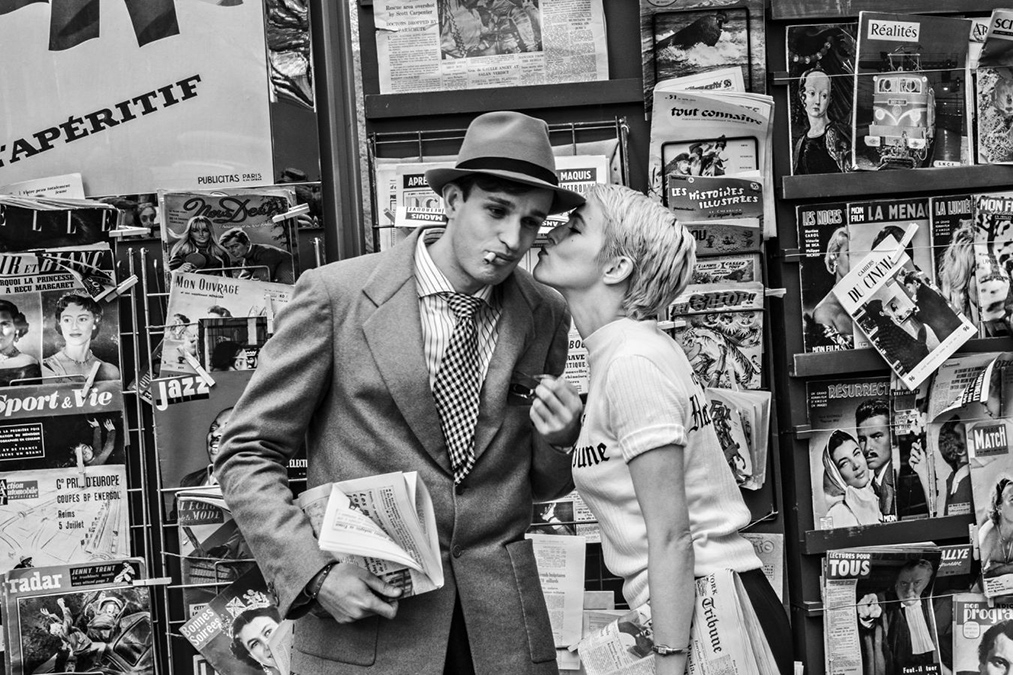
The French New Wave was born in the pages of the “Cahiers du Cinéma” magazine in the 1950s. Its writers, including François Truffaut, Claude Chabrol, Eric Rohmer, Jacques Rivette and Jean-Luc Godard, championed a new vision of cinema that would discard the plodding adaptation of literary classics, and instead make films that exploited and expressed stories using film as an artform in its own right.
François Truffaut was the first to transform these ideas into reality with his coming-of-age drama The 400 Blows in 1959. Using another story by Truffaut, Godard and Truffaut developed a screenplay for A bout de souffle (Breathless) that firmly put the French New Wave on the cinematic map and has had a lasting impact on film scholarship and cinematography.
Director Richard Linklater pays homage to the importance of Breathless” with Nouvelle Vague. In what he describes as inky monochrome, using the very Eclair Cameflex camera used by Raoul Coutard in the original film, Linklater shows us behind the scenes of the making of this classic.
At its core is Godard played by Guillaume Marbeck, who captures the enigmatic and eccentric manner of his directing style. The small Eclair camera allowed Godard to film in small hotel rooms and the city streets of Paris unencumbered by the restrictions of a traditional film studio. By employing Coutard as his cinematographer, who was trained as a war photographer, Godard had an able ally who was able to fulfill his freewheeling approach to filmmaking. Played by Matthieu Penchinat, he is continually bemused by having to film long tracking shots using a wheelchair or hidden inside a small cart.
“Nouvelle Vague” directly copies iconic scenes from “Breathless” and shows how Jean Seberg, a Hollywood star, played by Zoey Deutsch, is exasperated by Godard’s relaxed approach to directing. In contrast, her co-star, a former boxer, Jean-Paul Belmondo, played by Aubry Dullin, goes with the flow, much like his character in the film.
It also underlines how Godard was not concerned about the linear progression of scenes or continuity if it slowed down the pace or rhythm of the action. Sections were edited out of scenes, thereby giving the impression of a sudden jump. These so-called “jump cuts” are disconcerting to the viewer, as you are robbed of knowing what happens between the edit.
Godard was not interested in the psychological motivation of a character, and in particular Michel, his leading man, carries out random acts of violence. Things just happen, to make us feel more like this is a story unfolding before us rather than being observers of an artfully edited production that has been planned out long before the cameras roll.
One word of warning: the characters in Nouvelle Vague all talk as if they have swallowed a dictionary of pretentious quotations and constantly swap them with each other. Fortunately, the film is full of humour, zest and charm and is never weighed down by the intellectual verbiage.
For any film student or cineaste they can appreciate the film’s many references to films and filmmakers of that period, much as “Breathless” itself did. This might make it sound like something for a select audience, yet even without any background knowledge this captures the frustrations and excitement of discovering and exploring the power of cinema, and the passion of the cinephiles behind the New Wave.

Comments
No comment yet.