
It’s fair to say that cinema has found a great deal to mine from Shakespeare. Whether it’s the man himself, hurrying along to the playhouse, trying to stave off writer’s block, in John Madden’s Shakespeare in Love, or Laurence Olivier’s smiling villain, played-to-camera, in Richard III, the adaptations – and interpretations – keep on coming.
Adapted from Maggie O’Farrell’s novel, Hamnet imagines the family Shakespeare left behind in Stratford to pursue his theatrical career in London. The scraps of information we have about them – names, ages and not a lot else – are par for the course. The actual hard-and-fast details we have about Shakespeare wouldn’t fill a pamphlet. Having heard about Shakespeare’s young son, Hamnet, dying of the plague aged 11, O’Farrell’s instincts told her this was a story worth telling. O’Farrell extended these bare links of biography to create a novel of grief and love. Published in the year of our own, 21st century plague, O’Farrell’s novel became a soaraway success, landing in the New York Times’ Best Books of 2020.
The story of Hamnet begins with a preface: in Shakespeare’s time, the names Hamnet and Hamlet were considered interchangeable. The novel encourages us to question our ideas of what is assured and fixed. Hamnet was a twin: his sister Judith was considered physically weaker – she is the reason Shakespeare’s family didn’t move up to London with him. When she contracted the plague, her brother also caught it. Judith survived, Hamnet did not. While Shakespeare travels back from London to be with his children, their mother, Agnes, struggles to hold back the illness. A gifted herbalist, her affinity with nature is marked by a yearning to wander through the local woods. But her remedies are no match for the plague (now easily treatable with antibiotics). The film doesn’t look away from Hamnet’s suffering: untreated, a death from the plague takes up to 10 days. What Hamnet then does is examine how this grief works its way through the boy’s parents. A few years later, Shakespeare writes Hamlet. While ostensibly a play about – well, everything – the book suggests that the similarity in the names, Hamnet and Hamlet, are too close to be a coincidence.
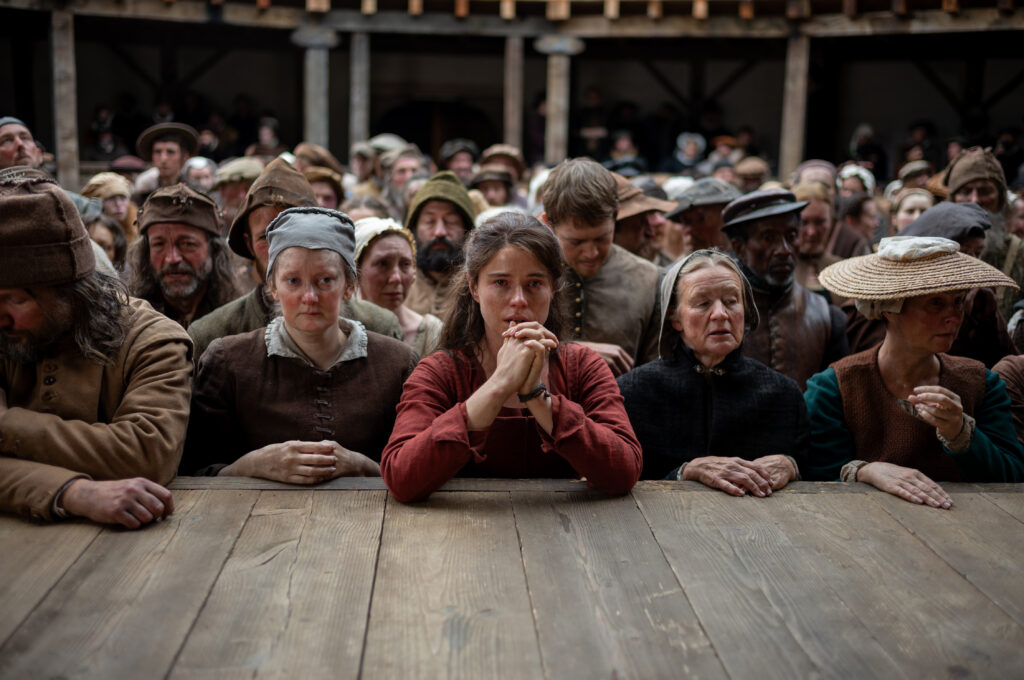
In the challenge of translating O’Farrell’s ethereal and mystic prose onto the screen, director Chloe Zhao’s answer is to mire the viewer in the physicality of Agnes and Will’s world. Zhao’s cinematographer, Lukasz Zal, guides us through the mossy, muddy forest that Agnes loves. You can virtually taste the damp in the air. The layers of sound: from the calls of animals and birds, to Max Richter’s beautifully understated score; anchor us in the couple’s reality. We watch closely as Agnes prepares herbal treatments: Zhao’s camera is intent on not losing a single detail. This is far removed from our usual notions of Shakespeare’s life: the theatre doesn’t appear until the very last scenes of the film. We see him struggle to gain a foothold: his bullish father (played by John Wilmot) insists he join the family gloving business, but Shakespeare’s stitching simply isn’t up to it. John’s frustrations spill over into violence: it’s clear that Shakespeare needs to leave home.
Played by Paul Mescal, Shakespeare gets a far more central role in the film, compared to the book: there, he is not referred to by name, merely “the playwright”. There is room to manoeuvre in the characterisation of the playwright. We know so little of him, for definite, there’s no ‘wrong’ way to play the man. Mescal gives him a nervy, diffident energy that plays well against Jessie Buckley’s earthy, grounded portrayal of Agnes. There has been a great deal of Oscar buzz around Buckley’s performance, and rightly so. Framed by Zhao’s tightly held close-up, Buckley portrays a mother’s despairing grief with everything she’s got. The scene where Hamnet dies is preceded by Agnes’ blind panic, feeling among her tools and potions for anything, anything that will work. It is the desperation that Zhao wants us to feel. Buckley’s interpretation of Agnes’ grief, and anger, is instinctive and beautifully nuanced. It could not be bettered.
We see Hamnet’s parents struggle to continue with their lives. Hamnet is great at reminding us of what nonsense it is to assume that parents of this era were inured to child mortality. The casting for this film, across the board, is superb, and Jacobi Jupe’s performance as Hamnet, is engaging and charming. When the boy dies, it is not just his parents that feel it: the emotional intensity for the film audience is notably heightened. In her grief, Agnes seems stuck. As Shakespeare’s fame and wealth grow, he buys a plot of land to build the biggest house in Stratford. She is caught in a mindless repetition of domesticity. It isn’t until her stepmother presses into her hand a bill from Shakespeare’s theatre, for his new play, Hamlet, that she is galvanised into furious action. She must see the play that has “taken Hamnet’s name”. What she sees in London will mean a fundamental shift for both herself, and her relationship with her husband.
Along with Jessie Buckley’s performance creating headlines, Hamnet has received a mixed reception among the critics. While it had a glowing reception at London Film Festival (not a dry eye in the house), others have called the film “emotionally manipulative” and even “Shakespeare fan fiction”. It is worth remembering that while O’Farrell created a great deal from scratch, out of creative necessity, at its heart, Hamnet still refers to the death of an actual 11-year-old boy. No effective treatment, no pain relief. You either got better, or you didn’t. Zhao and O’Farrell show Hamnet’s death for what it was: agonising and without mercy. As for “fan fiction”, there can’t be a definitive take on Shakespeare, as the source material simply isn’t there. You have to work around the plays and the few scraps of information we do have. While O’Farrell’s Shakespeare is more in the shadows, Mescal gives us the weight of a man pulled in different directions.
In its depiction of parental grief, Hamnet is less “manipulative” than remarkably restrained. It is the quieter moments of their performances, that we see Mescal and Buckley dig into what loss really means, and how it evolves. While Zhao waters down the mystical elements in O’Farrell’s novel, we don’t lose its emotional depth. By pivoting away from the stage, we see Shakespeare, and his family, more fully. It is the change in perspective that delivers this new story. It is not so much moving on, as moving forward.
Hamnet is screening at Plymouth Arts Cinema from Friday 23rd January – Wednesday 4th February.
Reviewed by Helen Tope






Comments
No comment yet.